
Sports Betting Risk Management: A Complete Guide for Sportsbook Operators



AI-assisted. Reviewed by KodeDice Editors.
Introducing Risks in Sportsbook
Every time a market goes live or expanded, operators bear proneness to certain sports betting platform risks and operational vulnerabilities. What makes the difference between a sustainable book and a vulnerable one is its robust control on liability, payments, compliance, etc. A sustainable sportsbook usually keeps them all controlled in the same system - in real time, with transparency and ownership.
What is risk management in sports betting?
In sports betting, risk management is the process to identify, evaluate and mitigate operational and financial risk factors that may appear from the player, operational, or external sources. This involves contingency planning, exposure monitoring, fraud controls and continuous betting risk analysis, all of which are central to how innovative iGaming solution providers design modern platforms.
Effective risk management for sportsbooks protects three things at once: the experience of legitimate players, operators’ capital, and the market integrity. The goal is to secure profit margin, revenue and prevent fraudulent activities.
Balancing Risk Control With Player Experience
Operators must balance risk controls with a strong player experience. While limits help filter unprofitable activity, overly restrictive approaches can also limit access for valuable recreational players. To remain competitive, operators must figure out profitable risk management strategies.
The Core Categories of Sportsbook Risk
Sportsbook risks fall into five clear categories - market financials, operational, player frauds, legal, and reputational. While each of these categorical risks are prone to serving the immediate threat to a sportsbook, demands considerable attention and monitoring across all of these.
| Category | Examples | Business Impact |
|---|---|---|
| Financial and Market risks | Significant payouts, margin volatility, incorrect odds leads to delayed market adjustments, spikes during same-game parlays and live betting | Limited margins, increase in trading exposure, liquidity pressure, financial loss. |
| Operational & Technological Risks | Platform outages due to high traffic, live odds inaccuracy due to feed disruption, internal process failure, black swan events interrupting trading assumptions. | Poor customer experience, decreased revenue, interruption in operational efficiency. |
| Fraud & Financial Crime Risks | Payment card misuse, multi-accounting challenges, collusion between bettors, attempt of money laundering activities. | Financial loss, account abuse, reduced operators profit. |
| Legal & Regulatory Risks | Unable to match KYC and AML requirements, tax and licence-related issues. | Rise in compliance cost , limited operations, fines and penalties. |
| Cybersecurity & Reputation Risks | Attacks on customer accounts, data leaks, infrastructure weak points and malware-related incidents. | Customer distrust, brand reputation damage, legal actions. |
Financial Risk & Liability Management
Financial exposure is the most visible risk for sportsbook operators. An operator can absorb occasional pricing mistakes, but recovering from sustained liquidity pressure is far more difficult. Large payouts, one-sided markets, and excessive concentration on major events can disrupt cash flow. It can even worsen in live betting environments, where exposure changes every minute. That is why liability management is paramount in sports betting risk management.
Odds Management, Line Movement & Book Balancing
By interpreting historical data, betting patterns, market movement and real-time signals from sports data providers, modern sportsbooks manage odds and line movement. Book balancing manages liability across outcomes by adjusting odds and limits. Dynamic limits, player segmentation, hedging and diversified exposure keeps operators secure from volatile markets, sharp bettors and concentrated betting activities. This is where the importance of payment segmentation also visibly appears from a 360-degree angle.
Dynamic Betting Limits & Exposure Monitoring
With dynamic betting limits operators can adjust maximum stakes as per player profiles, events, markets and current exposure. Real-time exposure monitoring helps to track multiple markets, to know about concentrated betting activity in advance. These features limit excessive exposure while delivering appropriate betting opportunities for dynamic player segments.
Black Swan Events & Margin Volatility From Bet Builders/Same-Game Parlays
Bet builders and same-game parlays can amplify exposure during unexpected events due to their complex correlations. Black swan events i.e., the unpredictable and extremely rare occurrences like suspended matches, sudden injuries, feed failures can affect betting combinations and cause high-impact consequences. To effectively manage margin volatility, operators require active monitoring, predefined exposure limits and stress testing.
Liquidity Management & Payout Readiness
During major sporting events, large payouts and high betting can pressurize sportsbook liquidity. To manage this, operators require efficient cash-flow monitoring to settle winning bets. They can maintain payouts with effective liquidity management while lowering down financial disruption risk.
Stake Acceptance
Stake acceptance must reveal the risk associated with markets, individual players, events and potential liabilities. Operators can put wider limits on recreational players to keep a control on high-risk and sharp bettors. Through behavioral monitoring and risk indicators, operators can evaluate when stakes should be restricted, reviewed and accepted as per standard controls.
Player Profiling & Customer Risk Segmentation
| Dimension | Advanced Player | Casual Player |
|---|---|---|
| Typical Behavior | Excellent market knowledge, mindful betting, selective wagers and consistent betting strategy | Recreational betting, diverse selection, lower stakes and less predictable betting strategy |
| Risk Treatment | Controlled limits, risk assessment as per betting behavior | Standard limits and routine risk controls unless additional risk indicators arise. |
| Monitoring Level | Continuous betting pattern, stakes and market monitoring | Standard monitoring emphasized on unusual behavior or change in activity |
Along with financial risk, behavioral monitoring helps operators with responsible gambling signals like unusual rise in betting frequency, large stakes, extended betting sessions or chasing losses. These signals help operators to maintain a safe and controlled betting ecosystem.
Fraud Prevention: A Three-Layer Framework
Fraud is not a single large incident. It often gives small warning signs, right from suspicious betting patterns, transaction activities to bonus abuse. Usually these activities are associated with bad-faith actors using multiple accounts or payment methods.
To address this, modern operators must undergo sportsbook compliance licensing guide and their fraud prevention activities should come with behavioral analytics and technical security controls, alongside curated content from leading game providers and partners integrated via secure APIs. Many iGaming software suppliers have a combination of two or all the three aspects.
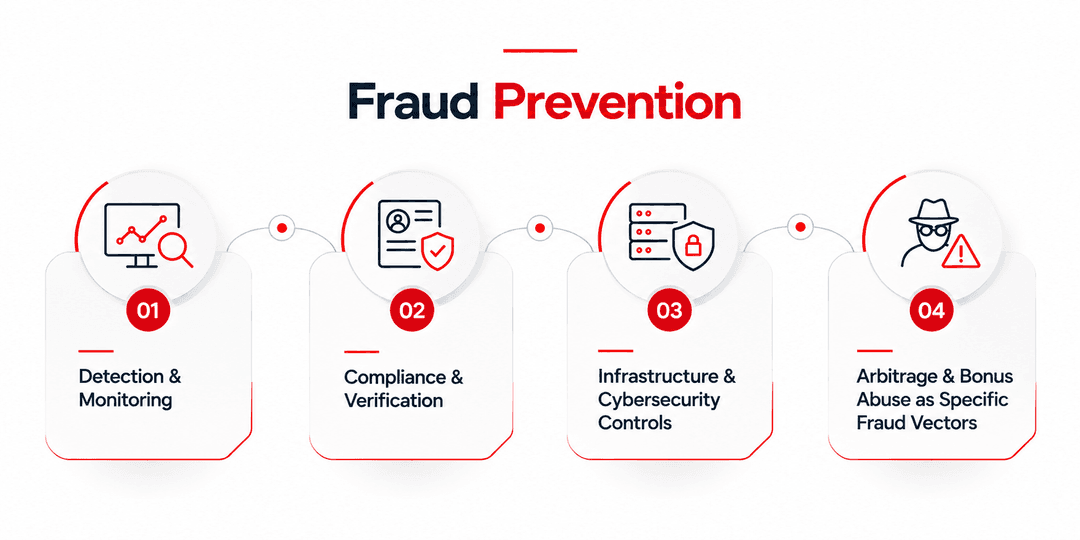
Detection & Monitoring
- Analysis of suspicious betting patterns with AI and ML fraud prevention algorithms to identify red flags.
- Detection of multiple accounts and collusion to prevent fraud. As per the UK Gambling Commission, 587 fraud or suspicious betting reports were found between April 2025 to March 2026, reflecting the crucial role of robust betting activity monitoring [2].
Compliance & Verification
- Anti-money laundering (AML) strategies.
- Continuous cash flow and payment transactions monitoring to enhance safety.
Infrastructure & Cybersecurity Controls
- Strict access control with multiple authentication.
- Security audits with vulnerability testing to protect sensitive data.
Arbitrage & Bonus Abuse as Specific Fraud Vectors
- Identifying players that exploit price differences and betting odds.
- Evaluating multiple accounts, coordinated activities responsible for bonus abuse, as well as monitoring distinct models like social and sweepstakes sportsbook platforms where abuse patterns can differ.
AI & Data-Driven Risk Management
Most of the risk management services today use machine learning models to manage real-time exposure and track market movements, mirroring the capabilities of an AI-driven sportsbook with dynamic odds. In today’s betting environment, market conditions are highly dynamic especially during high-volume football or basketball.
To handle this volatility, operators rely on automated monitoring systems to process historical data, real-time data feeds, betting trends and regulated markets.
Core application covers a broad roadmap of AI use cases for sportsbooks and casinos, similar to the iGaming and sportsbook AI integration strategies that are now shaping the industry:
Real-Time Liability Monitoring
AI-enabled pricing and trading systems to monitor exposure levels across different events and betting markets.
Predictive Player Behavior Modeling
With this modeling, operators can evaluate betting and gambling activity, and bonus fraud through machine learning.
Automated Anomaly Detection
Algorithms analyse transaction behavior, betting patterns and account activity in less time.
Dynamic, Algorithm-Driven Odds Adjustment
AI-driven pricing models enable tracking of marketing conditions and external data feeds in real-time.
For a Deeper Look at AI in Sportsbook Operations
AI helps operators to identify player activity, modify odds, detect anomalies and manage exposure in real-time. A structured roadmap for sportsbook AI integration helps align these capabilities with long-term strategy.
Regulatory Compliance & Reputation Risk
Regulatory compliance controls risks for sportsbook operators, by directly streamlining financial exposure, licensing continuity and brand credibility. Building a compliance framework is an important aspect for operators to remain compliant with evolving regulatory requirements while applying the right compliance control across all regulated markets, increasingly supported by RegTech in iGaming.
AML/KYC Obligations Across Jurisdictions
Regulatory expectations continue to rise. The UK Gambling Commission’s Money Laundering and Terrorist Financing Risk Assessment assigns a high risk rating to the remote betting sector citing vulnerabilities around non-face-to-face customers, bet structuring, and potential collusion. Operators must keep documents related to risk-based customer due diligence, risk assessment and suspicious activity reports wherever required, and watch for signs their iGaming compliance process cannot scale across multiple markets.
Responsible Gambling Requirements
Responsible gambling includes bet limits, self-exclusion, player risk assessment and behavioral interventions, which are now core elements of must-have features for modern sportsbook platforms. The aim is to build a secured gaming platform to reduce regulatory and reputational risks.
Managing Multi-Jurisdiction Compliance at Scale
Multi-market demands a comprehensive compliance architecture with jurisdiction specific rule configurations. With real-time monitoring, automated regulatory workflows, audio logs, configurable controls and compliance reporting, operators attain scalability while ensuring consistent governance across various licensing regimes, especially when supported by an iGaming risk management system for casino and sportsbook operators.
Governance & Operational Risk Management
Risk management is shaped by both technology and governance structures. Both internal policies and operational accountability decides the readiness of sportsbooks under pressure. Operators following robust risk processes have clear responsibilities across compliance, trading, payments and customer operations, and typically invest in the top tools iGaming operators need to support those teams.
With structured internal controls, escalation procedures and audit processes it becomes easy for teams to respond faster during operational issues, particularly when supported by managed services for iGaming operators that handle critical operations at scale.
In-House vs. Outsourced Trading & Risk Management
Internal trading management provides complete freedom to operators over pricing, exposure and customer segmentation. But building and maintaining an internal team demands skilled resources, and excellent operational support.
Many operators on the other hand work with sportsbook suppliers for trading services and infrastructure, to make expansion easy with less operational pressure, often opting for turnkey sportsbook solutions for sports betting that accelerate launch.
Separation of Duties & Internal Controls
To reduce conflicts many operators manage compliance, trading and financial functions separately. With robust workflows, audit trails, access restrictions, transaction monitoring, and regular reconciliations, operators can gain required strength in accountability, including a secure payment system for iGaming that centralises controls.
Crisis Preparation, Incident Response & Stress Testing
The most recurring challenge in sportsbooks is operational disruption. Here countermeasures like recovery protocols, frameworks and communication procedures can reduce financial and reputational impact.
Nowadays, operators regularly do stress testing by putting payments, security and infrastructure under stimulated pressure to test their weak points. The chances of operational disruption are higher during major sporting events where volumes can catch platforms off guard. Even a short delay is not acceptable as it can lead to delayed payment, bets and revenue.
Building a Sports Betting Risk Management Plan: Best Practices
Sportsbook risk management plan manages operational, market, fraud, financial, technology and regulatory risks through structured evaluation. Its goal is to retain profitability while delivering operational stability and seamless player experience.
Regular Risk Reviews Across Trading, Payments, Compliance & Infrastructure
Risk analysis should be regularly done across payments, trading, compliance and infrastructure. By evaluating financial exposure, betting patterns, regulatory changes, system performance and emerging potential threats, operators can control updates accordingly, especially when they rely on sportsbook API integration for betting platforms that continuously changes data flows and dependencies. They can also evaluate infrastructure weakness through regular audits to avoid operation disruption.
Testing System Resilience During High-Traffic Events
Frequent infrastructure testing is a must to ensure system capability of managing high transaction volumes and user activities. Stress testing allows operators to know weak points of scalability, payment and service-availability, which is particularly important when running an advanced AI-driven sportsbook platform. This testing is done before expecting exceptional traffic during major sports events.
Continuous Monitoring & Strategy Updates
Risk management is a continuous process. It allows operators to identify potential risks and betting patterns through automated monitoring, real-time data and reporting. Strategies should be modified and reviewed to show technological, regulatory, market and competitive changes.
Key Metrics & KPIs to Measure Risk Management Effectiveness
Risk management teams require measurable KPIs to know how operators evaluate, control and respond to fraud, financial and market risks. Tracking these parameters help risk teams to manage performance and continuously refine their strategies.
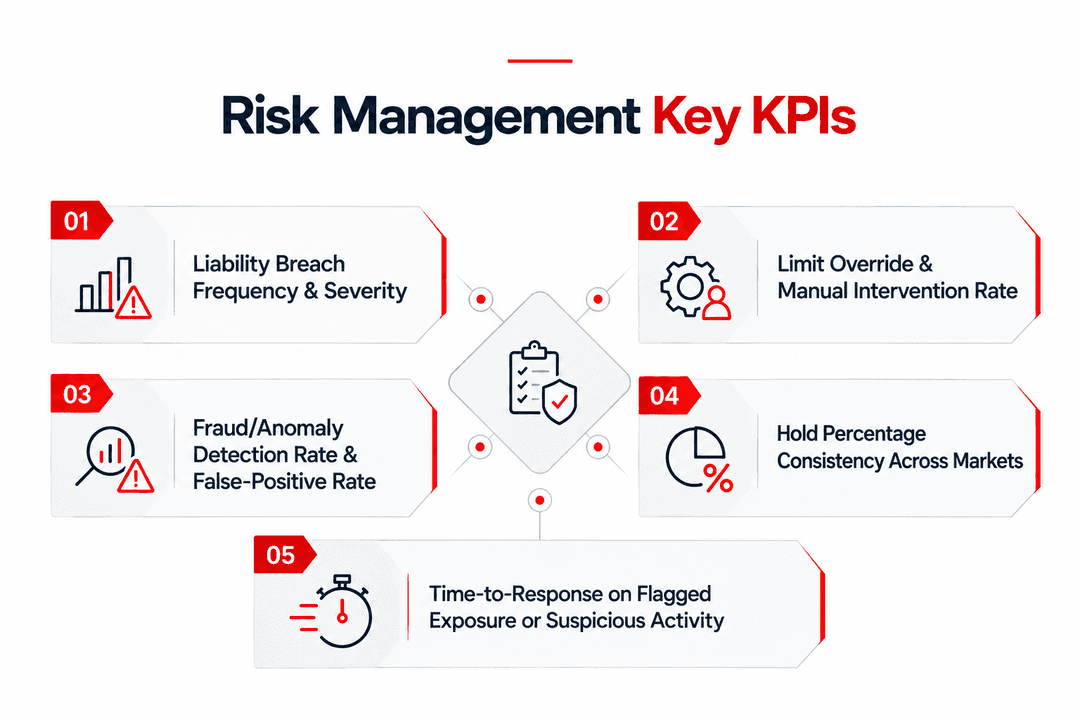
Liability Breach Frequency & Severity
Operators must track both financial exposure and how many times the liability threshold is breached. A rising trend reflects delayed line movement, limit models weakness or inefficient real-time monitoring.
Limit Override & Manual Intervention Rate
Track how many times the automated limits are overridden. Higher numbers indicate the need for recalibration of risk models or lack of flexibility for various player segments.
Fraud/Anomaly Detection Rate & False-Positive Rate
Determine the time taken by the system to evaluate genuine threats and legitimate activities. It should identify suspicious behavior on priority while lowering down false positives. This reduces restrictions on recreational players.
Hold Percentage Consistency Across Markets
Track hold percentage for events, sports and jurisdictions. Any change can indicate pricing issue, heavy sharp activity or issue with same-game parlay.
Time-to-Response on Flagged Exposure or Suspicious Activity
Operators must check the response time of their risk team for high-priority alerts. This time should be in minutes to avoid any escalation, which is where dedicated managed services for sportsbook and casino operations can add significant value.
How KodeDice Supports Sportsbook Risk Management
Modern sportsbook platforms increasingly embed risk management capabilities directly into the trading and compliance stack. With KodeDice’s sportsbook, operators can avail features like automated sharp-player detection, real-time exposure tracking, configurable AML/KYC workflows and dynamic limits across various jurisdictions.
Real-Time Trading & Liability Tools
KodeDice helps operators with dynamic betting controls, real-time exposure tracking, automated sharp-player detection, AI-powered margin, odds management and line balancing.
AI-Driven Fraud & Anomaly Detection
KodeDice allows operators to track fraud betting activities, abrupt player behavior, and anomalies through AI-driven sportsbook fraud detection, similar to broader AI and ML fraud prevention in iGaming. With this analysis operators can mitigate risk signals and can address the potential threats immediately. Thus, they can run sportsbook operations securely across all regulated markets and reduce the likelihood of financial losses due to fraud or suspicious matches.
Compliance-Ready Infrastructure Across Markets
KodeDice manages dynamic market operations with jurisdictional compliance capabilities that include responsible gaming, AML/KYC workflows, audit, regulatory reporting and configurable compliance processes, underpinned by RegTech solutions for automated compliance. This infrastructure supports operators in maintaining compliance with various regulatory frameworks and mitigating reputation risk.
Conclusion
A proactive approach combined with liability controls, compliance, fraud prevention, and continuous monitoring can result in effective risk management strategies. Operators can create a safe betting environment and establish regulatory compliance by adopting strategies and assessing exposure to various factors that impact sportsbook operations.
Blog Questions
Have a Specific
Question? Let's Talk.
Our solutions team responds within 4 business hours.
No sales pitch unless you ask for one.
The best risk management software must include real-time liability tracking, fraud detection, dynamic odds adjustment, detailed reporting & audit trails, and comprehensive KYC/AML checks.
An impactful fraud prevention strategy must cover regulatory compliance, proactive operational measures, transactional monitoring, device intelligence, and advanced technology to protect operators from financial crimes and match-fixing.
No, both are different. Odds management primarily involves pricing bets and maintaining competitive margins, while risk management focuses on fraud detection, regulatory compliance, exposure control, and financial risk across the sportsbook.
Sportsbook liability management is a critical aspect of risk management that involves tracking and controlling the financial exposure which a sportsbook may face on any specific market or event and is a core function of any advanced sportsbook solution like LOGAN.
Inefficient risk management may damage operators' reputation, reduce profit margins, erode customer trust, and decrease operational efficiency.
The decision relies on the availability of technology, expertise, and resources. In-house teams enjoy greater control, while outsourcing allows operators to access automated monitoring and scalable risk-management capabilities from specialized providers, including turnkey sportsbook solutions for fast deployment.