
How Will Crypto in iGaming Dominate 2026



AI-assisted. Reviewed by KodeDice Editors.
Introduction: Why Crypto Matters for iGaming in 2026
Cryptocurrency will have evolved from a niche payment alternative into the foundational infrastructure of global iGaming even before the end of 2026.
Driven by the mass adoption of stablecoins and the transparency of provably fair algorithms, crypto-integrated platforms are now expanding at twice the rate of traditional online casinos and crypto casinos.
Statistically, the impact is undeniable: cryptocurrency now facilitates nearly 17% of all global iGaming wagers. Despite the rise of diverse altcoins, Bitcoin remains the industry’s primary engine, commanding a dominant 66% of all crypto-based betting volume1.
The Rise of Crypto in iGaming: Market Growth and Adoption
The crypto iGaming sector is rapidly expanding, projected to exceed $100 billion by the end of 2026 due to widespread blockchain technology integration and growing global user adoption. Stablecoins play a crucial role by offering volatility protection and enabling instant, cross-border online gaming transactions—advantages traditional payment processors and bank transfers lack.
The total iGaming market is expected to handle crypto accounting for about 25% of all activity. Player adoption of cryptocurrencies like Bitcoin and Ethereum is rising sharply, with average crypto wager values 20–25% higher than fiat bets.
This shift is driven by lower transaction costs, faster settlements, and enhanced privacy, prompting operators and players worldwide to favor cryptocurrency transactions over traditional online casinos for a more efficient, secure, and borderless gaming experience.
What Makes Crypto iGaming Different from Traditional Online Gambling?
The primary distinction between crypto iGaming and traditional online gambling lies in the underlying infrastructure of trust and financial processing. While traditional sites rely on centralized banking, traditional payment methods, and third-party verification, crypto platforms utilize decentralized ledgers and blockchain networks to eliminate intermediaries.
| Aspect | Traditional Online Gambling | Crypto iGaming Platforms |
|---|---|---|
| Payout Time | 24 Hours to 7 Days | Instant to Minutes |
| Verification | Lengthy KYC/Document Uploads | Wallet-based or Minimal KYC |
| Game Integrity | Centralized/Third-party Audits | Blockchain-based Provably Fair Gaming |
| Fees | High (Credit Card/Bank Fees) | Minimal (Network Gas Fees) |
| Payment Speed & Cost | Pending periods of 3–5 days; high fees | Near-instant withdrawals; significantly lower fees |
| Privacy & Anonymity | Extensive personal documentation required | Pseudonymized gaming with crypto wallets-based authentication |
| Transparency & Fairness | Private audits of RNG | Public verifiable outcomes via blockchain |
| Global Accessibility | Limited by regional banking restrictions | Borderless access, including underbanked regions and crypto friendly markets |
| Chargeback Risk | Vulnerable to chargeback fraud | Transactions irreversible, protecting operators |
| Security | Centralized systems prone to data breaches | Decentralized encryption, multi-signature wallets, hot and cold storage |
| Operational Speed | Manual approvals causing delays | Automated smart contracts enabling instant payouts and automated payouts |
| Player Experience | Longer wait times and higher friction | Smooth, fast, and user-friendly experience with enhanced transparency |
| Market Reach | Requires localized banking partnerships | Scales globally via decentralized payment layers and multiple cryptocurrency options |
| Player Value | Lower average bet sizes and engagement | Higher lifetime value, larger bets, and tokenized loyalty |
| Regulatory Compliance | Traditional KYC/AML processes | Hybrid verification merging on-chain analytics with KYC under regulatory oversight |
How Crypto Will Dominate iGaming by 2026
The dominance of cryptocurrency in the gambling sector is driven by a convergence of technological maturity, payment processing innovations, and shifting global regulations. As we move through 2026, the following trends define the industry's trajectory.
1. Market Size and Global Adoption Forecast
The market is projected to reach $65 billion by 2026, with crypto wagers growing twice as fast as fiat. Global adoption is surging as digital assets become the primary betting medium, facilitating cross border payments and secure transactions.
2. Technological Standards: Provably Fair 2.0
Next-generation cryptographic hashing allows players to audit every game, especially the mini casino game, outcome in real-time. This "Provably Fair 2.0" standard eliminates the need for third-party testing labs and ensures absolute mathematical integrity, enhancing transparency and consumer protection.
3. Regulatory Landscape: The Move to “Green” Markets
Jurisdictions are shifting toward "green" licensing, where crypto-native operators are fully regulated. Frameworks like MiCA provide the legal certainty required for massive institutional investment. Further, the integration of smart tools like CRM and PAM secure player protection within the regulatory environment.
4. Emerging Player Experiences: Metaverse and Telegram Bots
Betting is migrating into social ecosystems. Telegram casino bots allow for frictionless, instant wagering within chat interfaces, while Metaverse casinos offer immersive, VR-driven gambling experiences that mimic real-world social interaction and enhance player engagement.
5. Gamification via NFTs and DAO Governance
NFTs now represent unique in-game assets and loyalty status, providing players with full control and true ownership. Simultaneously, DAO governance allows the community to vote on platform updates and share in operational profits.
6. Institutional Integration
Major financial institutions and payment processors are now providing the liquidity backbone for iGaming. This integration bridges the gap between traditional finance and decentralized gambling, stabilizing the entire ecosystem's capital flow and improving risk management.
7. Stablecoins and Efficiency
Stablecoins have solved the problem of price volatility. By using pegged assets, operators provide the speed and low cost of blockchain while ensuring players' bankrolls remain stable and predictable.
8. Market Leadership
Innovation-led brands that adopted blockchain early are now the primary market leaders. These "crypto-first" operators are outcompeting legacy brands by offering superior transparency, faster payouts, and lower operational overhead.
9. Key Sectors
Growth is concentrated in high-speed, data-driven markets:
- eSports Betting: Perfect alignment with the tech-savvy, crypto-native demographic.
- Provably Fair "Crash" Games: High-velocity gaming that requires sub-second blockchain finality.
- Decentralized Poker: Peer-to-peer rooms governed by smart contracts to ensure pot security.
9. Political Influence
The growing economic weight of the crypto iGaming sector is beginning to influence global policy. Governments are increasingly viewing the industry as a vital source of tax revenue and technological innovation.
How Crypto Changes the iGaming Business Model
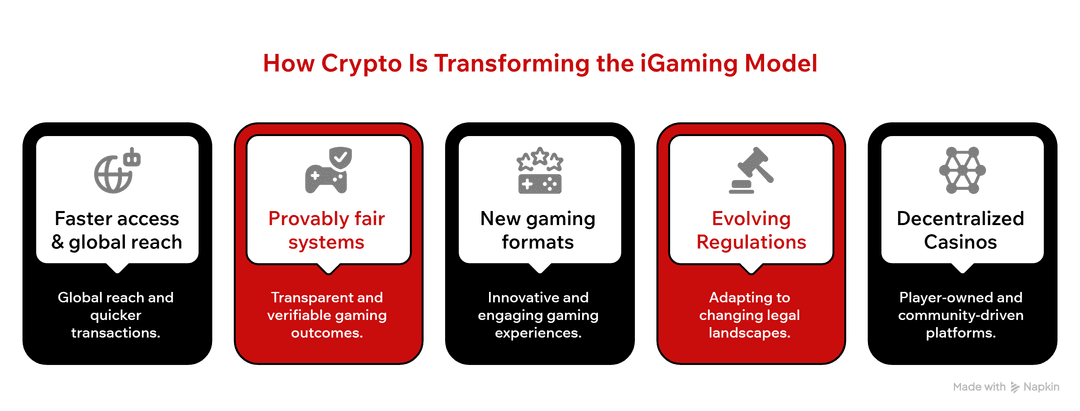
1. Speed and Accessibility
By leveraging blockchain technology, operators have eliminated the traditional 3–5 day "pending" period for withdrawals. In 2026, Instant Payouts are standard, while Layer-2 Scalability allows thousands of low-cost transactions per second. This infrastructure provides Global Reach, letting platforms bypass regional banking friction and serve underbanked markets efficiently. The improved transaction speed and reduced reliance on banking hours make cryptocurrency payments a faster alternative to traditional methods – certainly transforming the future of instant payouts in casino.
2. "Provably Fair" Transparency
Blockchain’s Immutable Records ensure every game outcome is verifiable on a public ledger, ending the era of "black box" algorithms. Smart Contract Automation distributes winnings instantly without human intervention, while decentralized Player Verification lets users prove identity and age securely, balancing privacy with regulatory compliance. This ensures transparency and fairness within the iGaming ecosystem, enhancing player trust and engagement.
3. Emerging Trends and Gaming Formats
The industry has shifted toward Stablecoin Dominance to protect player bankrolls from volatility while maintaining speed. Gamification and NFTs offer true asset ownership, letting players trade loyalty rewards. The rise of Metaverse and Social Bots on platforms like Telegram simplifies betting into a seamless, community-driven social experience. These innovations support in play betting and live events, attracting a broader audience to crypto gaming.
4. Regulatory Maturation
The MiCA Framework in the EU provides legal certainty for institutional growth, transforming crypto gambling into a respected financial sector. Operators use Hybrid Verification systems merging traditional KYC with on-chain analytics, meeting anti-money laundering standards without sacrificing the streamlined onboarding that defines crypto-first gaming. Ensuring transparency and compliance is critical for sustainable growth in the iGaming industry.
5. Decentralized Casinos (dApps)
Decentralized applications represent the pinnacle of innovation, operating entirely on-chain without central authority. These platforms use autonomous protocols to manage the "house," sharing profits via DAO governance. This model offers the highest transparency and fee-efficiency, fundamentally challenging traditional corporate casinos and redefining the future of crypto gaming.
Security and Transparency of Crypto Payments - Operators' Perspective
a. Key Aspects of Crypto Payment Security
- Irreversibility & Finality: Once a transaction is confirmed on the blockchain, it cannot be reversed. This protects operators from "chargeback fraud," a common issue in traditional credit card payments.
- Immutable Ledger: Every deposit and withdrawal is recorded on a permanent, time-stamped ledger. This prevents data tampering and provides a clear financial trail for both players and auditors.
- Consensus Mechanisms: Networks use Proof of Stake (PoS) or Proof of Work (PoW) to validate transactions. This decentralized verification ensures that no single entity can manipulate payment flows or account balances.
- Risk Mitigation: By utilizing multi-signature wallets and cold storage, operators can isolate player funds from online threats, significantly reducing the surface area for large-scale hacks.
b. Transparency in Crypto Transactions
- Public Visibility: Anyone can view transaction hashes on a block explorer. This level of openness ensures that casino reserves are solvent and that winning payouts are actually being processed.
- Pseudonymity: While transactions are public, they are tied to wallet addresses rather than sensitive personal data. This protects the player's identity from data breaches while maintaining a transparent audit trail.
- Verification: Smart contracts allow for real-time verification of "Return to Player" (RTP) percentages, ensuring the house edge is exactly as advertised without requiring a leap of faith.
c. Privacy and Security Challenges
- Wallet Security: The "be your own bank" philosophy means players are responsible for their private keys; losing access to a seed phrase results in a permanent loss of funds.
- Social Engineering: As technical security improves, attackers pivot to phishing and "dusting attacks" to trick users into revealing credentials or interacting with malicious contracts.
- Privacy Coins: Assets like Monero provide enhanced anonymity but face increasing scrutiny from regulators (like the MiCA framework) who require clear AML/KYC pathways for legal compliance.
Liquidity and Financial Strategies Holding Crypto
Liquidity is the cornerstone of a sustainable crypto iGaming operation, acting as the bridge between digital assets and real-world utility.
For operators, maintaining high liquidity ensures that the platform can facilitate instant payouts regardless of transaction volume, fostering player trust and long-term retention. A liquid ecosystem also provides a buffer against extreme price volatility, allowing for more stable fund management and predictable operational costs.
Effective financial strategies often involve a balanced mix of "Hot Wallets" for immediate transaction processing and "Cold Storage" for long-term asset protection. By prioritizing liquidity, platforms can execute efficient currency conversions and hedge against market swings.
Conversely, low liquidity can lead to withdrawal delays and "slippage" during exchanges, which frustrates players and compromises the platform’s reputation.
Ultimately, a robust liquidity strategy transforms volatile digital assets into a reliable financial engine for 2026's competitive crypto iGaming market.
The Currencies That Matter in Crypto iGaming (2026)
In the 2026 market, the success of a platform depends heavily on its asset selection. Operators must balance player demand with financial stability by categorizing coins based on their utility and risk profile.
Preferred Currencies (The Gold Standard):
- Bitcoin (BTC): The most trusted and widely held asset, essential for high-value players and popular for bitcoin transactions in iGaming.
- Ethereum (ETH): The primary choice for smart-contract-based casinos and decentralized apps, supporting cryptocurrency integration.
- Stablecoins (USDT/USDC): The industry favorite for eliminating volatility while maintaining instant digital speeds, facilitating wallet setup and seamless place bets.
- Litecoin (LTC): Frequently used for smaller bets due to its low fees and proven reliability, favored in sports betting contexts.
Currencies to Avoid:
- Obscure Altcoins: New or low-cap coins often lack the liquidity needed for large payouts.
- Meme Tokens: Extreme volatility makes these risky for both player bankrolls and operator margins.
- Low-Adoption Networks: Coins without wide wallet support create unnecessary technical friction for users.
Success Patterns from Crypto iGaming Operators
To thrive in the competitive 2026 landscape, leading operators are moving beyond basic crypto payments and adopting specialized operational blueprints. These success patterns focus on maximizing user trust and leveraging blockchain-native features to drive engagement.
1. Instant Payouts
Top platforms use automated liquidity pools to process withdrawals in seconds. This immediate gratification is the strongest driver for player retention, distinguishing crypto sites from slow-moving traditional casinos.
2. Provably Fair Games
Operators integrate cryptographic algorithms that allow players to verify the randomness of every round. This transparency eliminates skepticism, building a foundation of trust that legacy "black box" systems cannot provide.
3. Low Transaction Fees
By utilizing high-throughput networks like Solana or Polygon, successful operators keep overhead minimal. These savings are often reinvested into more competitive odds and lower minimum deposit requirements for players.
4. Stablecoin Integration
Integrating USDT and USDC has become standard practice. This strategy protects both the house and the player from market swings while maintaining the technical advantages of blockchain-based settlement.
5. Tokenized Loyalty
Modern loyalty programs use branded tokens or NFTs instead of generic points. These assets hold real-world value, allowing players to trade rewards or benefit from the platform’s overall growth.
6. Influencer-Led Growth
Successful brands partner with crypto-native influencers and streamers on platforms like Kick and Telegram. This creates authentic, community-driven marketing that resonates far better than traditional banner advertisements or spam.
7. Telegram Mini-Apps
Operators are increasingly launching entire casinos within Telegram. These "Mini-Apps" offer a frictionless, one-click gaming experience that bypasses app stores and utilizes the messenger’s massive built-in social network.
8. Micro-Betting
Blockchain efficiency enables "micro-betting," where players can wager tiny fractions of a cent on granular events. This encourages high-frequency play and appeals to a broader, casual audience worldwide.
9. Hybrid Libraries
Leading platforms offer "Hybrid Libraries" that combine classic casino slots with decentralized "GambleFi" games. This mix caters to traditional gamblers while attracting DeFi enthusiasts looking for innovative mechanics.
10. Community DAOs
The most advanced operators use Decentralized Autonomous Organizations (DAOs) to give players a voice. Token holders can vote on new game additions or profit-sharing models, creating deep brand investment.
Crypto Currencies That Work in Practice for Online Betting
While many tokens exist, only a handful possess the technical infrastructure required to handle the high-frequency demands of modern online betting. Success in practice requires a combination of network throughput, cost-efficiency, and widespread exchange support to ensure players can move funds without friction.
| Cryptocurrency | Typical Payout Speed | Average Network Fee | Best For... |
|---|---|---|---|
| Solana (SOL) | < 1 Minute | Extremely Low (<$0.01) | Live Betting & High Frequency |
| USDT (TRC-20) | 2–5 Minutes | Low ($1.00) | Budgeting & Stability |
| Litecoin (LTC) | 10–20 Minutes | Very Low ($0.05) | Micro-betting & Efficiency |
| Bitcoin (BTC) | 30–60 Minutes | Variable (Medium) | Long-term Holdings & VIPs |
| Ethereum (ETH) | 5–15 Minutes | Variable (High) | Smart Contracts & dApps |
Pros and Cons of Crypto in iGaming
| Pros | Cons |
|---|---|
| Instant Liquidity: Withdrawals are processed in minutes, bypassing multi-day bank delays. | Price Volatility: Sudden market swings can significantly devalue player balances or operator margins. |
| Lower Costs: Eliminates high intermediary fees from banks and credit card processors. | Regulatory Uncertainty: Shifting global legal frameworks can lead to sudden licensing or access hurdles. |
| Enhanced Privacy: Players can wager using digital wallets without sharing sensitive bank details. | Technical Barrier: Users must manage private keys and wallets; lost credentials mean permanent fund loss. |
| Chargeback Protection: Transactions are final and irreversible, protecting operators from payment fraud. | Irreversibility Risks: Incorrect wallet addresses or accidental transfers cannot be recovered or refunded. |
| Global Access: Enables borderless participation for users in regions with restricted banking. | Anonymity Concerns: High levels of privacy can complicate Anti-Money Laundering (AML) compliance. |
Operator Perspective: Building a Crypto-First iGaming Platform by 2026
Building a crypto-first iGaming platform by 2026 requires shifting from "crypto-supported" to "crypto-native" operations. In this landscape, blockchain isn't just a payment addon; it’s the core architecture.
With the global crypto gambling market projected to exceed $65 billion this year and digital wagers claiming nearly 17% of the total global handle, operators must move beyond legacy thinking. Success now depends on deep-level integration where games, loyalty systems, and liquidity management all live directly on the chain to meet the demands of a high-speed, transparent market.
| Decision Area | Strategic Implementation (2026 Standards) |
|---|---|
| Chain Selection | Prioritize high-throughput Layer-2s like Arbitrum or Solana to ensure sub-second bet finality and near-zero gas fees for high-frequency play. |
| Wallet Infrastructure | Implement non-custodial "Web3 logins" (like MetaMask or Phantom) to provide a frictionless, "no-account" experience that prioritizes user privacy and asset control. |
| Withdrawal Processing | Use automated smart contracts to trigger instant payouts. Eliminating manual approvals is now the #1 driver for player acquisition and long-term retention. |
| Exchange Rates | Integrate real-time price oracles (like Chainlink) to ensure fair, transparent conversion between crypto wagers and game-engine fiat values without hidden spreads. |
| Compliance Stack | Deploy on-chain AML tools that scan wallet risk scores in real-time, satisfying global regulators while maintaining the speed of a crypto-native environment. |
The State of iGaming Marketing in 2026: Why Crypto Changes Everything
By early 2026, iGaming marketing has matured from niche speculation into a dominant, high-growth sector where crypto-native tactics lead mainstream engagement. With the online gambling market projected to surpass $65 billion in Gross Gaming Revenue (GGR) this year, crypto-integrated platforms are expanding at twice the velocity of traditional online casinos.
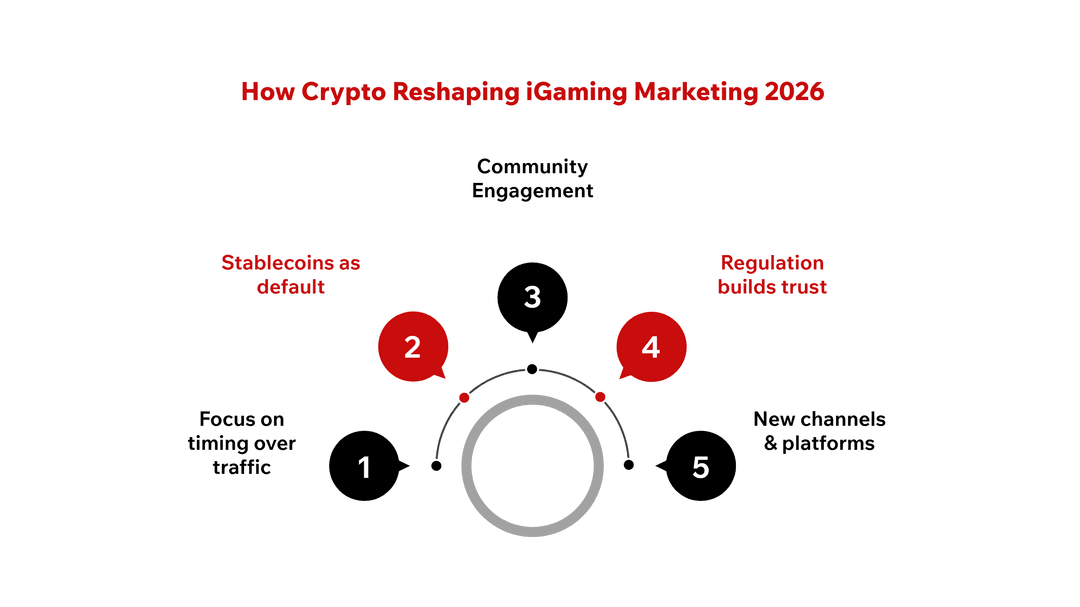
1. Shift from "Traffic" to "Timing": Marketing now focuses on real-time triggers and instant liquidity, capturing players exactly when they have active cryptocurrency wallet balances rather than relying on broad, slow-burn funnel ads.
2. Stablecoins as Default: Using USDT or USDC stablecoins is now a primary marketing hook, promising players protection from market crashes while maintaining the technical perks of digital assets.
3. The Rise of "GambleFi": Marketing emphasizes community ownership through Decentralized Autonomous Organizations (DAOs) and tokenized rewards, turning players into stakeholders who promote the platform themselves.
4. Regulatory Legitimacy: Compliance with frameworks like the EU’s Markets in Crypto-Assets Regulation (MiCA) is used as a "trust badge" in ads to attract institutional-grade users and risk-averse players.
5. Emerging Channels: Engagement has migrated to Telegram bots and Metaverse lounges, allowing for frictionless, "one-click" betting directly within social ecosystems, enhancing player behavior and retention.
Forecasts and Trends for 2026
The iGaming landscape is entering a transformative era where blockchain technology is no longer an outlier but the industry standard. By late 2026, market growth will be fueled by the total integration of stablecoins, providing the necessary financial bridge for mainstream players seeking speed without volatility in online gambling.
We are witnessing a decisive shift toward "regulated decentralization," where global compliance frameworks provide the legitimacy needed for institutional scale in crypto gaming. Furthermore, the rise of automated smart contracts will make sub-second, auditable payouts the baseline expectation for all global operators in the crypto iGaming sector.
The Future of Crypto iGaming
The future of the sector lies in the convergence of immersive technology, decentralized finance (DeFi), and blockchain-based gaming platforms. Beyond simple cryptocurrency payments, the next phase of iGaming will be defined by player-governed ecosystems and cross-chain interoperability across multiple blockchain networks. We expect a surge in "GambleFi" platforms where transparency is enforced by code, not just policy.
As blockchain features like non-fungible tokens (NFTs) and Decentralized Autonomous Organization (DAO)-driven bonuses become secondary nature, the distinction between "crypto" and "traditional" casinos will vanish, leaving behind a unified, high-efficiency digital betting economy driven by user autonomy and global accessibility.
Blog Questions
Have a Specific
Question? Let's Talk.
Our solutions team responds within 4 business hours.
No sales pitch unless you ask for one.
Legality varies by jurisdiction. In 2026, the EU’s MiCA framework provides clear rules, while the US remains a state-by-state patchwork. Many regions now offer specific "crypto-native" licenses.
Bitcoin remains the volume leader at 66%, followed closely by Ethereum for smart contracts and USDT/USDC stablecoins, which players prefer for their price stability and near-instant settlement.
It eliminates banking intermediaries, reducing fees from 5% to under 1%. Transactions that once took days are now settled in minutes, providing the instant liquidity modern players demand.
Primary risks include extreme market volatility affecting bankrolls, the technical responsibility of managing private keys, and the irreversibility of transactions if sent to the wrong address.
Unlikely. While CBDCs offer speed, they lack the pseudonymity and decentralized "provably fair" mechanics of crypto. Most 2026 operators view CBDCs as a fiat bridge rather than a total replacement.